Data Centers, Water and Noise: Can Growth Stay Sustainable?
Data centers are becoming the backbone of AI, cloud services, healthcare, finance and everyday digital life. Their growth matters, but so does a fair question for nearby communities: how much water and noise can one area absorb?
How much water are we talking about?
Lawrence Berkeley National Laboratory estimated that U.S. data centers directly consumed about 65 billion liters of water in 2023. That works out to roughly 20,600 liters, or 5,450 gallons, every 10 seconds. The U.S. Environmental Protection Agency says the average American family uses a little over 300 gallons per day at home. In simple terms, every 10 seconds the national data-center sector directly uses about as much water as 18 households use in a full day. This is a national total, not the consumption of one facility.
Cooling design, climate, server efficiency and location can change water demand dramatically.
Why nearby communities are concerned
The issue grows when large facilities are built where water is already under pressure.
In The Dalles, Oregon, city records reported by Oregon Public Broadcasting show Google used about 434 million gallons in 2024, around one-third of the city’s total consumption. City officials say planned water-system expansion is for broader future growth, not Google alone, while environmental groups remain concerned about local water resources.
In Santiago, Chile, an environmental court required Google to revise part of its data-center assessment because of possible pressure on an aquifer already affected by long-term drought.
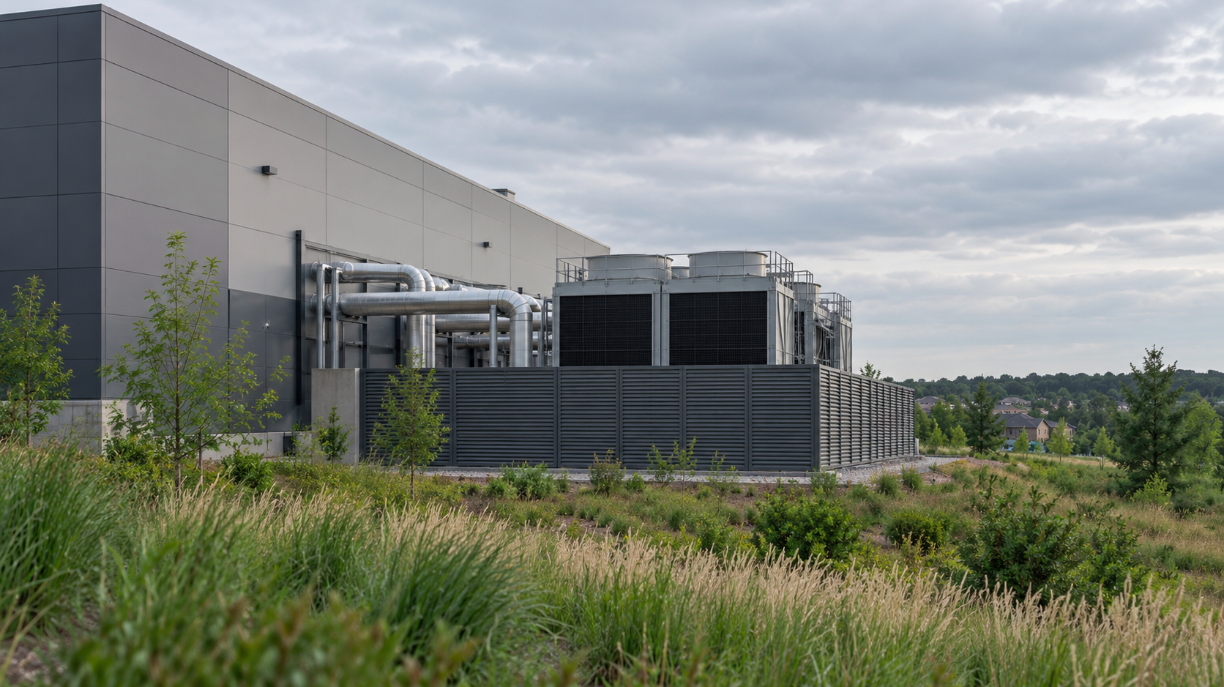
Noise is another concern. Virginia’s Joint Legislative Audit and Review Commission found that some residents near data centers report that constant low-frequency sound affects their well-being. The same review noted that most data centers do not generate noise complaints when well located and properly designed.
Are governments doing anything?
Yes. The focus is increasingly on smarter siting and design, rather than stopping data-center growth.
Virginia has moved toward stronger noise oversight, including sound-impact assessments for certain new facilities and statewide noise rules due by the end of 2029. Its JLARC review also recommended giving local governments clearer authority to request water-use estimates and sound modeling before projects are approved.
Oregon has created a statewide Data Center Advisory Committee to study water, energy, land use and community impacts with public input.
What researchers are saying
The research is serious, but it is not anti-data-center.
A 2025 Lawrence Berkeley National Laboratory study by Nuoa Lei, Jun Lu, Arman Shehabi and Eric Masanet found that water use for similar workloads can vary by more than 10,000 times, depending on server efficiency, utilization, cooling technology, grid water intensity and climate. Their conclusion is important: there is no single solution, but better engineering and site-specific choices can make a very large difference.
UC Riverside researcher Shaolei Ren is more cautious. His 2026 research warns that U.S. communities may need billions of dollars in new water infrastructure to handle future peak demand. But the work is also solution-focused, pointing toward better efficiency, stronger local water capacity and smarter planning.
The path forward
Data centers are not going away, nor should they. They support services modern economies increasingly depend on.
Closed-loop cooling, more efficient servers, better utilization, careful site selection, sound modeling and stronger local planning can reduce the impact. The U.S. Department of Energy already highlights closed-loop and other water-saving cooling strategies as practical options
The future does not have to be a choice between digital growth and local communities. With better engineering, transparency and planning, data centers can keep expanding while using water more carefully and becoming better neighbors.