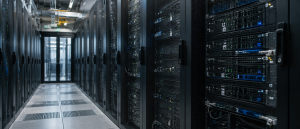
The world is running low on memory. And no, we are not talking about human forgetfulness. We are talking about the physical memory chips that power computers, smartphones, servers, and hyperscale data centers worldwide. In 2026, a global RAM shortage is underway, and artificial intelligence is the driving force behind it. The AI RAM shortage is no longer a prediction. It is a reality affecting businesses, IT providers, and consumers across the globe.
Modern enterprises are rethinking their IT asset management strategies as AI workloads consume massive amounts of high-performance memory, GPUs, and server resources. Many organizations are extending hardware lifecycles beyond traditional EOL meaning timelines because upgrading infrastructure has become significantly more expensive. This shift is increasing demand for server maintenance, EMC support, and managed infrastructure services that help businesses maximize existing hardware performance.
At the same time, AI is reshaping data center architecture. Memory-intensive AI workloads require advanced data center air conditioning, scalable storage environments, and continuous database monitoring to maintain performance. Companies are also investing in modular data centers and data center optimization strategies to support growing AI demand while improving sustainable IT infrastructure. Meanwhile, the rapid replacement of aging hardware is increasing the need for secure data destruction and IT asset disposition services.
If you have recently tried to upgrade enterprise infrastructure, purchase new hardware, or scale AI operations, you have likely already felt the impact of the 2026 RAM price increase and global RAM shortage. So, why is AI consuming so much memory, and how deep is its impact on the semiconductor industry? Let’s break it down.
Why Does AI Need a Lot of Memory?
For years, the average computer user felt that RAM was a solved problem. Eight gigabytes for office work, sixteen for gaming. The demands were steady. Then artificial intelligence changed the game overnight. We are not talking about small models. We are talking about massive language models and generative AI that require data to be instantly accessible.
The reason is simple. AI models are not just about raw calculation. They are about moving enormous quantities of data back and forth constantly. The brain of an AI does not just need a fast processor. It needs a giant, lightning-fast short-term memory pool to hold the entire world model at once. This is the core driver of the current memory chip shortage.
How AI Consumes Memory vs. Traditional Computing?
To understand the crisis, you have to see the difference in how AI uses hardware. Traditional software processes data in smaller chunks. AI, especially during training, needs to hold billions of parameters in memory simultaneously.
| Feature | Traditional Server Memory Use | AI Workload Memory Use |
| Data Pattern | Sequential, smaller batches | Massive parallel data sets |
| Capacity Need | Scales slowly with users | Scales massively with model size |
| Speed Priority | Low latency for databases | Massive bandwidth to feed GPUs |
| Upgrade Cycle | 3 to 5 years in data centers | Constant expansion, often within 1 year |
| Cost Factor | Minor part of total server cost | Major driver of infrastructure cost |
This table highlights why the demand shock is so intense. A single AI training cluster does not just need slightly more RAM. It needs orders of magnitude more than a standard corporate server farm.
Why are RAM Prices Suddenly Spiking in 2026?
You might wonder why AI chip demand NVIDIA AMD Google is a 2026 story. Did AI not exist before? Yes, but the scale has reached a breaking point. For two years, the industry absorbed excess inventory. Now, in 2026, the wave of next-generation AI inference and edge computing has collided with a fragile supply chain. The result is the dramatic DRAM price surge we see today.
Several forces have combined to create a perfect storm, answering the common question, why is RAM shortage happening in 2026.
- Exhaustion of Old Inventory: Memory makers previously held surplus stock. AI demand devoured these strategic reserves faster than anyone had forecasted.
- The Shift to HBM: Production lines are cannibalizing standard RAM capacity to make advanced memory for AI accelerators.
- Proliferation of Local AI: It is not just the cloud anymore. Powerful AI features are moving to smartphones and laptops, all of which need more unified memory and ultimately leading to global RAM shortage.
The Giant Demand for High Bandwidth Memory (HBM)
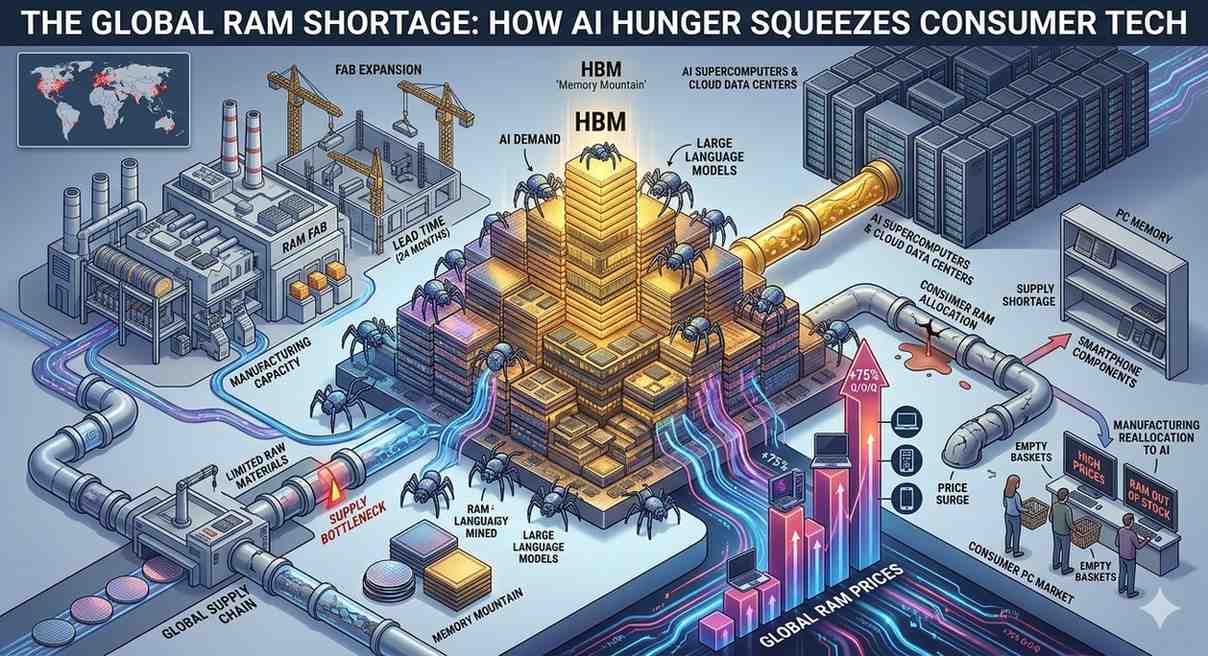
This is the single biggest technical reason for the shortage. High Bandwidth Memory, or HBM, is not your typical stick of RAM. It is a stack of memory dies connected by microscopic wires. Think of normal PC hardware storage as a two-lane road. Think of HBM as a hundred-lane superhighway.
NVIDIA, AMD, and Google are hungry for HBM because their AI chips cannot function without it.
- NVIDIA uses HBM for its H200 and B200 Blackwell GPUs. Each chip requires up to 192 GB of HBM.
- AMD relies on HBM for its MI300X series to stay competitive.
- Google custom designs its TPUs with massive HBM pools for its cloud services.
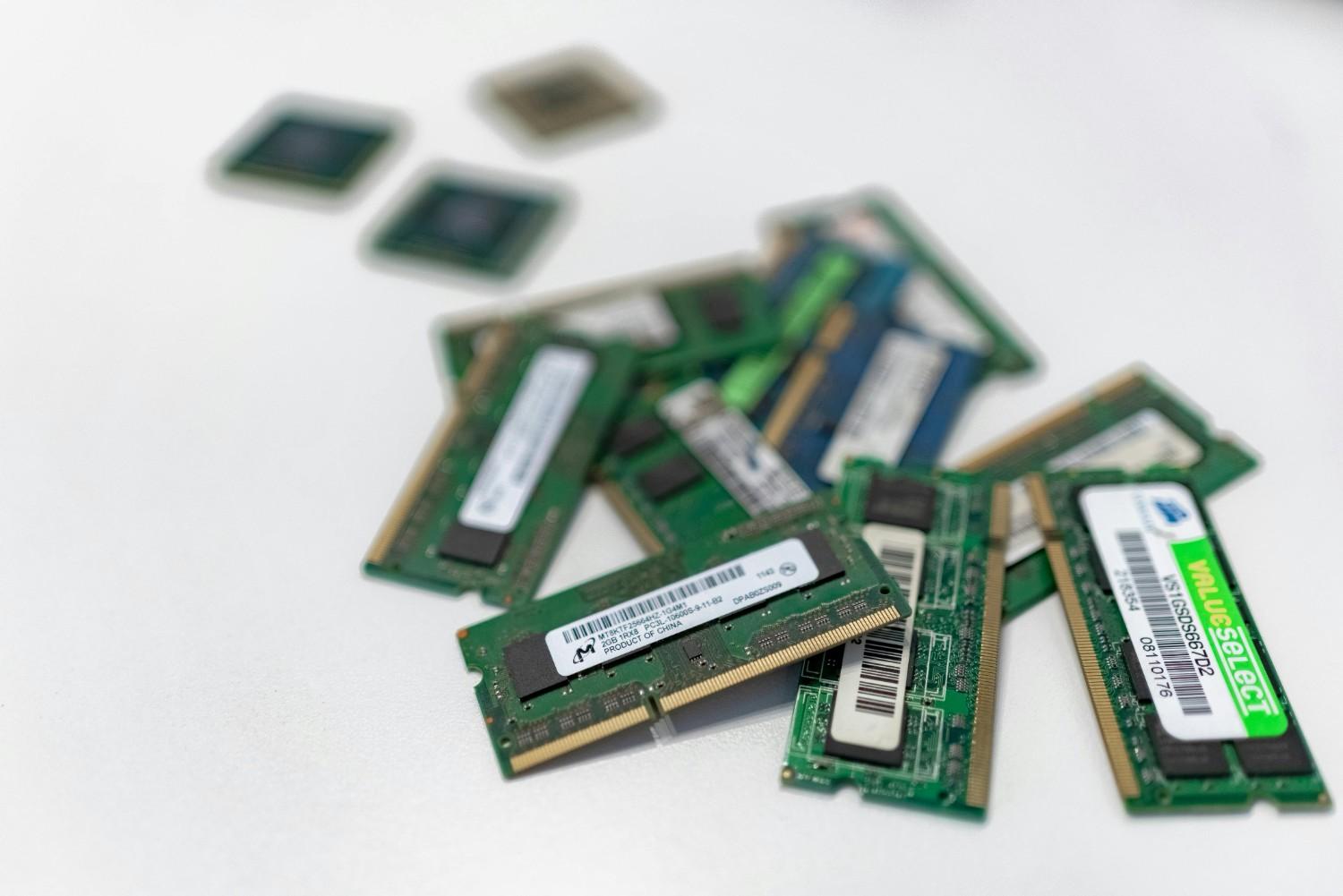
This insatiable high bandwidth memory HBM demand is reshaping the entire semiconductor supply chain issues. A fabrication plant, or fab, can make standard DDR5 RAM, or it can make HBM. The profit margins on HBM are much higher. Therefore, factory capacity shifts to HBM. This leaves less factory time for the standard memory used in laptops, desktops, and traditional data center architecture servers.
DRAM vs SRAM Demand: Two Different Pressure Points
To fully grasp the AI demand for memory, we must separate two key technologies. The DRAM vs SRAM demand story is about speed versus capacity. SRAM is blazing fast and built directly on the processor, but it takes up a lot of physical space. DRAM is slightly slower but much denser, making it good for large capacity.
AI chips need both. They need massive SRAM caches for instant calculations. But more critically, they need oceans of DRAM directly attached to the chip, or HBM.
Memory Type Comparison
| Memory Type | Speed | Capacity | Physical Size | Main Role in AI Today |
| SRAM | Instant | Kilobytes | Very Large (Expensive) | On-chip cache for immediate math |
| DRAM (Standard) | Fast (Nanoseconds) | Gigabytes | Medium (DIMM Sticks) | Bulk CPU memory, basic cloud tasks |
| HBM (3D Stacked DRAM) | Ultra Fast | Gigabytes per stack | Very Small (Silicon Stack) | GPU direct memory, the fuel for LLMs |
The problem is not a global RAM shortage or shortage of SRAM. It is a manufacturing bottleneck for advanced DRAM and HBM. The packaging technology to stack DRAM into HBM is incredibly difficult, and only a few companies can do it. This is a critical pinch point in the global memory market trends.
AI-driven infrastructure demands are increasing operational pressure on modern data centers. Explore practical strategies, maintenance insights, and real-world expenses in this guide on data center maintenance tips and real 2026 costs.
Cloud Computing’s Unending Appetite
It is not just the big AI labs. Walk into any mid-sized company today, and they are likely experimenting with AI tools hosted on cloud platforms. This massive adoption directly translates into cloud computing memory usage growth. Every time a cloud provider opens a new “AI instance” for a customer, it locks down a huge amount of memory that cannot be shared.
Previously, cloud servers could share memory resources between idle tasks. AI models, however, are greedy. They reserve their entire footprint in memory permanently to avoid slowdowns. This means cloud providers must buy double or triple the physical memory to serve the same number of customers, dramatically accelerating the memory chip shortage.
The Ripple Effect: From Data Centers to Your Desktop
How does this impact of AI on the semiconductor industry reach your office? It is pure economics. If a memory manufacturer can sell a wafer of chips to NVIDIA for data center memory consumption at a premium, they will not discount it for PC makers.
This is the direct cause of the RAM price increase 2026 andglobal RAM shortage. Production lines that made DDR5 for your workstation are switching to HBM for data centers. The supply of consumer and enterprise-grade DRAM falls, but demand remains stable. Prices must go up.
Here is what the current market landscape looks like:
Market Segment Price Pressure Analysis (2026)
| Segment | Cause of Strain | Price Impact |
| Consumer PCs & Laptops | HBM cannibalizing wafers starts for DDR5/DDR4. | High (15-25% increase YoY) |
| Enterprise Servers (CPU) | Cloud providers buying up remaining DDR5 supply. | Medium High (Prioritized, but costly) |
| AI Servers (GPU) | Exponential demand for HBM3E. | Extreme (Memory makes up 20-30% of GPU node cost) |
| Mobile (LPDDR) | On-device AI requires higher base RAM (12GB to 16GB+). | Medium (Phones cost more to make) |
The Roadblock in Manufacturing
You cannot simply flip a switch to make more memory. Memory manufacturing constraints are severe and long-term. Building a new semiconductor fabrication plant takes three to five years and costs north of $20 billion. The tools needed to etch chips smaller than a virus are made by a single company, ASML, and have year-long backlogs.
Currently, three major players control over 90% of the DRAM market: Samsung, SK Hynix, and Micron. They are spending billions to expand capacity, but these new factories will not produce chips at scale until 2027 or 2028. Right now, they are optimizing existing lines. And optimization today means prioritizing HBM profits, deepening the AI RAM shortage.
What is Causing the DRAM Price Surge Right Now?
To summarize the answer to “what is causing DRAM price surge“, it is a competition between silicon needs. AI training clusters need memory like a jet engine needs fuel. A single data center filled with NVIDIA H200 GPUs features memory pools measured in hundreds of terabytes. That one facility consumes the same memory volume as thousands of smaller enterprise servers.
This reallocation leads to a basic math problem:
- AI Accelerator Count in Data Centers: Growing 40% yearly.
- HBM Content per Accelerator: Growing 50% with every new chip generation.
- New DRAM Fab Output: Growing only 5% yearly due to construction lags.
When demand grows exponentially, and supply grows linearly, the result is a price explosion. This explains “how AI affects memory prices” and global RAM shortage in the simplest terms.
Bottom Line
Will the situation get better? Eventually, yes. But the definition of “normal” is changing. AI is not a fad. It is a permanent new layer of computing. This means the days of dirt-cheap, abundant RAM are likely over for this decade.
For businesses, AI infrastructure costs will remain high. Budgets must shift. The line item for memory will become a much larger percentage of IT spending.
To navigate the AI RAM shortage, consider these strategies:
- Plan Purchases Early: Do not wait for a failing stick of RAM to upgrade. Lead times are stretching out. Buy critical capacity now before the next quarterly price hike.
- Optimize Your Workloads: Do you really need a massive local model, or can a smaller, fine-tuned model work? Reducing model size is the most direct way to slash memory needs.
- Consider Older Hardware (Strategically): In some budget cases, expanding a slightly older DDR4 server with cheap used memory is a stopgap until the DDR5 and HBM markets stabilize. This cannot work for AI, but it can hold over standard file servers.
Technology has always been cyclical. But the AI era represents a resource transformation we have not seen since the dawn of the internet. Silicon is the new oil, and memory is the tank that holds it. The global memory market trends point to continued tightness as long as the race for dominant AI continues. As we move through 2026, understanding the answer to “will RAM prices go up due to AI?” is critical. The answer is a clear yes, and the only smart move is to adapt proactively to deal with global RAM shortage.
For more insights on managing your IT infrastructure during this volatile time, contact the team at Extended Tech Solutions. We help businesses benchmark their computing needs and purchase intelligently so you do not overpay for the AI revolution.
About The Author: