Modern enterprises rely heavily on IT infrastructure to maintain operations, security, productivity, and customer experience. But as hardware ages and Original Equipment Manufacturer (OEM) support becomes increasingly expensive, many organizations across the United States are turning toward Third-Party Maintenance Services as a smarter and more flexible alternative.
From servers and storage systems to networking equipment, third-party maintenance (TPM) helps businesses extend the life of critical IT assets without being locked into expensive manufacturer contracts.
Simply put, third-party maintenance allows companies to maintain and support IT infrastructure through an independent provider instead of the original equipment manufacturer (OEM).
This approach has become increasingly popular among enterprises managing:
- data centers
- hybrid infrastructure
- legacy hardware
- EOSL environments
- multi-vendor IT ecosystems
Personally, one major shift many IT leaders are noticing is that hardware often remains technically functional long after OEM support ends. Businesses today are realizing they do not necessarily need to replace infrastructure immediately simply because the manufacturer says support is ending.
That realization is driving major growth in the US TPM industry. Read on to know some real market insights on third-party maintenance services.
Why Are Third-Party Maintenance Services Growing So Quickly?
Many enterprises are under pressure to:
- reduce IT spending
- maximize infrastructure ROI
- avoid unnecessary hardware refreshes
- improve operational flexibility
According to Gartner, organizations are increasingly prioritizing cost optimization and infrastructure efficiency as part of long-term IT strategy.
At the same time, aging infrastructure remains extremely common across:
- healthcare
- finance
- manufacturing
- education
- enterprise data centers
This is where Third-Party Maintenance Services become valuable.
Instead of replacing fully operational equipment, organizations can continue maintaining infrastructure safely and strategically.
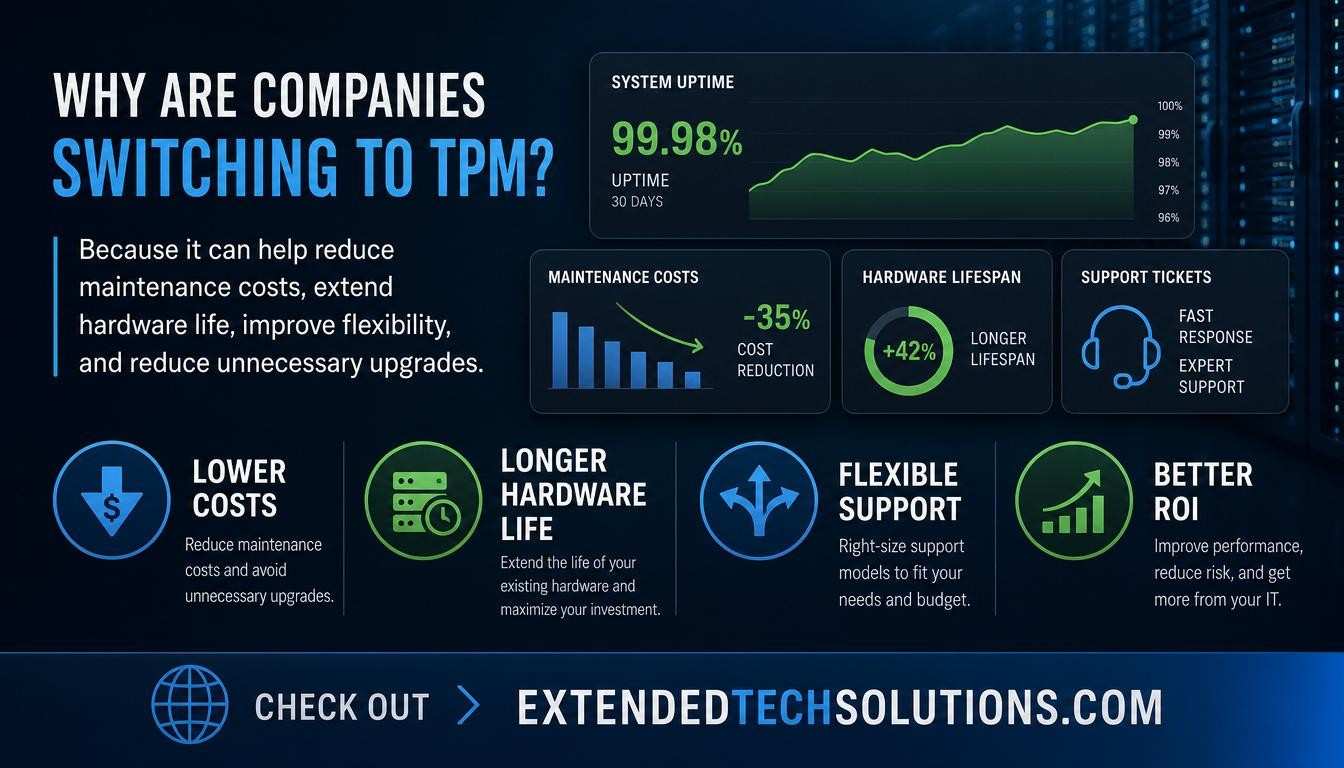
To better understand why enterprises are increasingly adopting Third-Party Maintenance Services, here’s a quick comparison between traditional OEM support and TPM models.
| Parameter | OEM Support | Third-Party Maintenance Services |
| Best For | New hardware environments | Legacy and mixed-vendor infrastructure |
| Cost Comparison | Higher annual support costs | More cost-effective and flexible |
| Hardware Refresh Needed | Often encouraged sooner | Can extend hardware lifecycle |
| Enterprise-Ready | Yes | Yes |
| Ease of Use | Vendor-specific processes | Centralized multi-vendor support |
| Best for Team Size | Large dedicated IT teams | SMBs to large enterprises |
| Multi-Vendor Support | Limited | Strong |
| EOSL Support | Often restricted | Commonly supported |
| Contract Flexibility | Standardized OEM SLAs | Customizable SLAs |
| ROI Optimization | Moderate | High infrastructure ROI potential |
How Third-Party Maintenance Works
Third-party maintenance providers support enterprise hardware after or alongside OEM support contracts.
These services often include:
- hardware replacement
- technical support
- on-site maintenance (HPE, Dell, Cisco, EOSL, etc)
- parts management
- multi-vendor support
- extended lifecycle management
Unlike OEMs that typically support only their own products, TPM providers often support mixed infrastructure environments.
OEM Support vs Third-Party Maintenance
| Feature | OEM Support | Third-Party Maintenance |
| Cost | Higher | More cost-effective |
| Contract flexibility | Limited | Flexible |
| Multi-vendor support | Usually no | Yes |
| Hardware lifespan | Pushes refresh cycles | Extends equipment life |
| Custom SLAs | Limited | Often customizable |
| Legacy support | Restricted | Stronger support for older systems |
One of the biggest advantages businesses notice is flexibility. Many OEM contracts are tied closely to refresh cycles, whereas TPM providers often focus on maximizing existing infrastructure value.
Key Benefits of Third-Party Maintenance Services
1. Lower IT Infrastructure Costs
One of the primary reasons companies adopt Third-Party Maintenance Services is cost reduction.
Organizations can often reduce maintenance costs significantly compared to OEM renewal pricing.
This helps free IT budgets for:
- cloud modernization
- cybersecurity
- AI initiatives
- infrastructure optimization
2. Extended Hardware Lifespan
Many servers, storage systems, and networking devices remain fully functional beyond OEM EOSL dates.
TPM allows businesses to:
- delay unnecessary upgrades
- maximize ROI
- reduce e-waste
- improve capital efficiency
Personally, many IT environments today still run stable legacy infrastructure that performs reliably years beyond OEM lifecycle recommendations.
3. Multi-Vendor Support Simplification
Modern data centers often include hardware from multiple vendors.
Managing separate OEM contracts can become:
- expensive
- fragmented
- operationally inefficient
TPM providers simplify support through centralized maintenance strategies.
This is especially useful for:
- hybrid data centers
- enterprise storage environments
- multi-platform server infrastructure
- Common Equipment Supported by TPM Providers
Most third-party maintenance services providers support:
- enterprise servers
- storage arrays
- networking equipment
- tape libraries
- hyperconverged infrastructure
- SAN switches
- backup appliances
Many businesses also seek support for legacy hardware after OEM contracts expire.
For example, organizations managing aging infrastructure often explore extended Tech Solutions EOSL Services.
When Should Businesses Consider Third-Party Maintenance?
TPM becomes especially valuable when:
- OEM maintenance costs rise significantly
- Hardware still performs reliably
- Budget optimization becomes important
- EOSL announcements create upgrade pressure
- Multi-vendor support becomes difficult
- Infrastructure refresh timelines need flexibility
Businesses do not always need immediate replacement simply because support contracts change.
That strategic flexibility is one reason TPM adoption continues growing across the United States.
Understanding EOSL in IT Infrastructure
EOSL stands for: End of Service Life.
Once hardware reaches EOSL:
- OEM support may stop
- replacement parts become limited
- renewal costs often increase
However, EOSL does NOT automatically mean hardware becomes unusable.
Many organizations continue operating stable infrastructure safely with third-party support providers.
To understand this topic further, businesses often research: EOL vs EOSL vs EOS.
Are Third-Party Maintenance Services Safe?
This is one of the most common concerns among enterprise IT teams.
To be honest, the answer depends heavily on:
- provider expertise
- SLA quality
- inventory management
- response capabilities
- engineering experience
Reputable TPM providers maintain:
- certified engineers
- replacement part inventories
- escalation systems
- enterprise-grade SLAs
According to the market data, lifecycle extension and infrastructure optimization remain important priorities for enterprises seeking operational efficiency.
Common Misconceptions About TPM
| Myth | Reality |
| TPM is only for old hardware | Many businesses use TPM strategically across environments |
| OEM support is always better | Depends on budget, flexibility, and infrastructure needs |
| EOSL hardware is unusable | Many systems remain operational for years |
| TPM increases risk automatically | Strong providers offer enterprise-grade SLAs |
How TPM Supports Sustainability Goals
Sustainability is becoming increasingly important for enterprise IT.
By extending hardware life, third-party maintenance services help reduce:
- electronic waste
- premature hardware disposal
- unnecessary manufacturing demand
This aligns with growing enterprise ESG and sustainability initiatives across the US market.
Signs Your Business May Need TPM
You may benefit from TPM if:
- OEM renewal pricing feels excessive
- infrastructure refreshes are delayed
- hardware still performs efficiently
- support contracts are fragmented
- you operate mixed-vendor environments
- budget optimization is becoming a priority
Many enterprises today are shifting from reactive hardware replacement toward lifecycle optimization strategies.
Why Businesses Choose Extended Tech Solutions
Organizations looking for flexible infrastructure support often seek providers capable of supporting:
- multi-vendor environments
- EOSL hardware
- data center optimization
- enterprise storage systems
Businesses exploring infrastructure lifecycle support can also review:
Extended Tech Solutions Third-Party Maintenance Services
Frequently Asked Questions
What are Third-Party Maintenance (TPM) Services?
Third-party maintenance services provide IT hardware support through independent providers instead of OEM manufacturers.
Is third-party maintenance cheaper than OEM support?
In many cases, TPM solutions are more cost-effective and flexible compared to OEM renewals.
What happens after EOSL?
After EOSL, OEM support may stop, but organizations can continue maintaining infrastructure through third-party support providers.
What equipment can TPM providers support?
Servers, storage systems, networking equipment, tape libraries, and many legacy enterprise platforms are commonly supported.
Is TPM suitable for enterprise environments?
Yes. Many enterprise organizations use TPM for lifecycle optimization, cost control, and multi-vendor infrastructure management.
Conclusion
As enterprise IT infrastructure continues evolving, organizations are increasingly looking for smarter ways to balance performance, operational continuity, and cost optimization.
That is exactly why Third-Party Maintenance Services have become such an important strategy across modern data centers and enterprise environments.
Instead of replacing functional hardware prematurely, businesses today are focusing more on:
- infrastructure lifecycle extension
- budget optimization
- multi-vendor flexibility
- sustainable IT operations
For organizations evaluating EOSL hardware support or infrastructure maintenance alternatives, partnering with an experienced TPM provider can help reduce costs while maintaining operational confidence.
To learn more about infrastructure lifecycle support strategies, visit Extended Tech Solutions EOSL Support Solutions or contact the team for customized guidance tailored to your enterprise environment.
About The Author: