The benefits of Third-Party IT Support go far beyond simple cost savings. Companies today use third-party IT maintenance to improve uptime, extend hardware lifespan, gain flexible SLAs, and avoid unnecessary infrastructure replacements. Whether you manage servers, storage systems, networking devices, or data center environments, third-party support can help maximize your IT investments without compromising performance.
More than ever before, organizations are increasingly prioritizing cost optimization and infrastructure lifecycle extension as key IT strategies. Similarly, there is a growing demand for flexible IT maintenance models outside traditional OEM contracts.
In this guide, we’ll explore the top benefits of third-party IT support and why modern enterprises are moving toward more scalable, cost-efficient maintenance solutions.

What Is Third-Party IT Support?
Third-party IT support, often called Third-Party Maintenance (TPM), is an alternative to manufacturer support services offered by OEMs like Dell, IBM, Cisco, HPE, or NetApp. Instead of relying solely on original manufacturers for maintenance and hardware support, businesses partner with specialized IT support providers.
These providers offer:
- Hardware maintenance
- Server support
- Storage maintenance
- Network infrastructure support
- End-of-service-life (EOSL) support
- Time and material
- Data center maintenance services
Unlike OEMs that push frequent upgrades, TPM providers focus on maximizing the lifespan and performance of your existing infrastructure.
For businesses dealing with aging systems, EOSL hardware, or shrinking IT budgets, third-party support offers a strategic advantage.
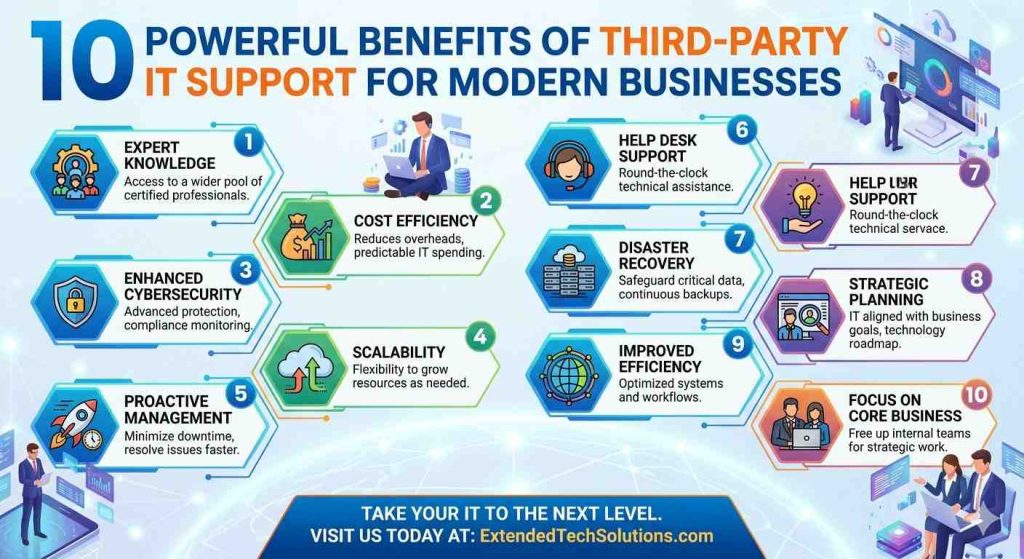
10 Powerful Benefits of Third-Party IT Support
Learn how third party IT support helps businesses reduce infrastructure costs, extend hardware lifespan, and improve operational flexibility. Learn the key benefits of choosing reliable IT maintenance solutions beyond traditional vendor support.
1. Significant IT Cost Savings
One of the biggest benefits of third-party IT support is cost reduction.
OEM support contracts often become expensive after the first few years of ownership. Many businesses end up paying premium prices for maintenance that doesn’t align with their actual infrastructure needs.
Third-party maintenance providers can reduce support costs by 40%–70% while still delivering enterprise-grade services.
Cost Comparison Table
Feature | OEM Support | Third-Party IT Support |
Annual Maintenance Cost | High | Lower & Flexible |
Hardware Refresh Pressure | Frequent | Minimal |
Contract Flexibility | Limited | Customized |
EOSL Support | Usually unavailable | Available |
Multi-Vendor Support | Limited | Centralized |
SLA Customization | Restricted | Flexible |
Response Times | Standardized | Tailored |
This makes TPM especially attractive for enterprises trying to optimize operational spending without sacrificing reliability.
2. Extended Hardware Lifespan
Many OEMs encourage businesses to replace equipment long before it’s truly necessary. However, enterprise hardware often remains functional for years after official support ends.
Third-party support helps businesses:
- Extend server and storage life
- Delay expensive infrastructure upgrades
- Improve ROI on IT assets
- Maintain stable environments longer
For example, organizations running Dell EMC, IBM, Cisco, or HPE infrastructure can continue using reliable systems well past OEM end-of-support dates through specialized maintenance services.
Businesses looking for infrastructure lifecycle management often explore EOSL Support Services to avoid unnecessary capital expenditures.
3. Flexible Support Contracts
Traditional OEM agreements often come with rigid contract structures and unnecessary bundled services.
Third-party IT support providers offer:
- Custom SLAs
- Tailored response times
- Multi-year support options
- Selective hardware coverage
- Scalable maintenance plans
This flexibility allows organizations to align IT support with operational priorities and budget goals.
The benefits of third-party IT support become even more valuable for businesses managing hybrid infrastructure environments or multiple data centers.
4. Multi-Vendor Infrastructure Support
Modern enterprises rarely operate within a single-vendor ecosystem.
A typical IT environment may include:
- Cisco networking
- Dell servers
- IBM storage
- HPE infrastructure
- NetApp systems
Managing multiple OEM contracts can quickly become complicated and expensive.
Third-party maintenance providers simplify operations by delivering centralized support for multi-vendor environments under one contract.
This improves:
- Vendor management
- Operational efficiency
- Support consistency
- Cost visibility
Companies looking for broader infrastructure coverage often use Third-Party Maintenance Services for unified IT support management.
5. Better Support for EOSL Equipment
One of the most valuable benefits of third-party IT support is continued support for End-of-Service-Life hardware.
OEMs often discontinue support to encourage hardware refreshes. However, replacing infrastructure prematurely can create:
- Budget strain
- Migration risks
- Downtime concerns
- Operational disruption
Third-party providers specialize in maintaining EOSL equipment safely and efficiently.
This allows organizations to:
- Maintain operational continuity
- Avoid rushed upgrades
- Extend infrastructure value
- Reduce unnecessary spending
Also read: EOL vs EOSL vs EOS: Must Know Before Their Hardware Goes Dark.
6. Faster Response Times
Many businesses assume OEMs automatically provide better support response times. In reality, third-party providers often deliver faster and more personalized service.
Benefits may include:
- 24/7 monitoring
- Dedicated account management
- Rapid onsite support
- Faster issue escalation
- Personalized technical assistance
Unlike large OEM support structures, TPM providers often focus on proactive customer relationships and tailored service delivery.
This improves uptime and reduces operational risk for mission-critical environments.
7. Reduced Downtime and Improved Uptime
Downtime can cost businesses thousands, or even millions, of dollars annually.
Third-party IT support helps reduce outages through:
- Preventive maintenance
- Proactive hardware monitoring
- Faster replacement logistics
- Customized maintenance strategies
For industries like healthcare, finance, manufacturing, and logistics, infrastructure reliability directly impacts revenue and customer trust.
The benefits of third-party IT support become especially important when business continuity and uptime are top priorities.

8. Greater IT Budget Control
Modern IT leaders need predictable budgeting and long-term infrastructure planning.
Third-party support enables businesses to:
- Forecast maintenance expenses more accurately
- Reduce surprise upgrade costs
- Shift from capital-heavy spending models
- Allocate budgets strategically
Instead of being forced into frequent refresh cycles, organizations gain more flexibility over when and how they invest in infrastructure modernization.
This helps IT teams balance innovation with financial efficiency.
9. Sustainable IT Infrastructure Strategy
Sustainability has become a major focus for enterprises across the USA.
Extending hardware lifespan reduces:
- Electronic waste
- Manufacturing demand
- Unnecessary equipment disposal
- Environmental impact
Third-party maintenance supports greener IT operations by helping businesses maximize the usable life of enterprise equipment.
According to market research, sustainable infrastructure strategies are becoming increasingly important in long-term IT planning initiatives.
Organizations seeking ESG-friendly operational models often see third-party maintenance as a practical sustainability solution.
10. Strategic Focus on Business Growth
When internal IT teams spend less time managing hardware maintenance complexities, they can focus on higher-value initiatives like:
- Cloud optimization
- Cybersecurity
- Digital transformation
- Automation
- Business innovation
Third-party providers handle infrastructure support while businesses prioritize strategic growth.
This operational efficiency is one of the most overlooked yet impactful benefits of third-party IT support for modern enterprises.
Why Businesses Are Moving Away From OEM-Only Support
Today’s enterprises need more than just standardized maintenance contracts.
They want:
- Flexibility
- Faster support
- Lower costs
- Lifecycle optimization
- Multi-vendor expertise
Third-party maintenance delivers these advantages while helping organizations maintain control over their IT environments.
As infrastructure costs continue rising across the USA, TPM is becoming a core strategy for businesses looking to optimize operations without sacrificing reliability.
Frequently Asked Questions
What are the benefits of third-party IT support?
The main benefits include lower maintenance costs, extended hardware lifespan, flexible SLAs, better EOSL support, and centralized multi-vendor management.
Is third-party maintenance better than OEM support?
It depends on business needs. Many organizations prefer TPM for cost savings, flexibility, and support for aging infrastructure, while OEMs may still be used for newer environments.
Can third-party IT support maintain EOSL hardware?
Yes. Third-party maintenance providers specialize in supporting end-of-service-life hardware after OEM support ends.
Does third-party IT support reduce downtime?
Yes. Many TPM providers offer proactive monitoring, rapid response services, and customized maintenance strategies to minimize outages.
Which industries benefit most from third-party IT support?
Healthcare, finance, manufacturing, logistics, retail, and enterprise data centers commonly benefit from TPM services.
Bottom Line
The Benefits of Third-Party IT Support extend far beyond reducing maintenance costs. Businesses today need flexible, scalable, and cost-efficient infrastructure strategies that align with long-term operational goals.
From extending hardware lifespan and improving uptime to supporting EOSL infrastructure and simplifying multi-vendor environments, third-party maintenance offers a smarter alternative to traditional OEM-only support models.
If your organization is looking to optimize IT spending while maintaining reliable infrastructure performance, explore the tailored support solutions available through Extended Tech Solutions. You can also review their specialized EOSL Support Services to keep critical hardware running efficiently beyond manufacturer support timelines.
About The Author: